Danfoss' contribution in the field of compressors is particularly outstanding, especially in the development and production of scroll compressors has made remarkable achievements:
Early stages: Danfoss originally started with the production of conventional piston compressors, which were mainly used in domestic and small commercial air-conditioning systems.
Introduction of the scroll compressor: In response to the need for higher efficiency and less maintenance, Danfoss began work on the development of the scroll compressor. Scroll compressors are favoured for their simplicity, few moving parts, smooth operation and high energy efficiency.
Technological innovation: Danfoss has continuously improved the design of its scroll compressors, such as introducing unique axial-radial sealing technology, optimised suction runner design and comprehensive electronic protection modules, making its products competitive in the market.
Sustainable development: In response to the global demand for environmental protection, Danfoss is committed to developing compressors that support low GWP refrigerants and actively promoting the use of environmentally friendly materials and technologies.
Danfoss offers a wide range of compressors to meet the needs of different applications. These include scroll, piston and other types of compressors, each with its own unique design features and application scenarios.
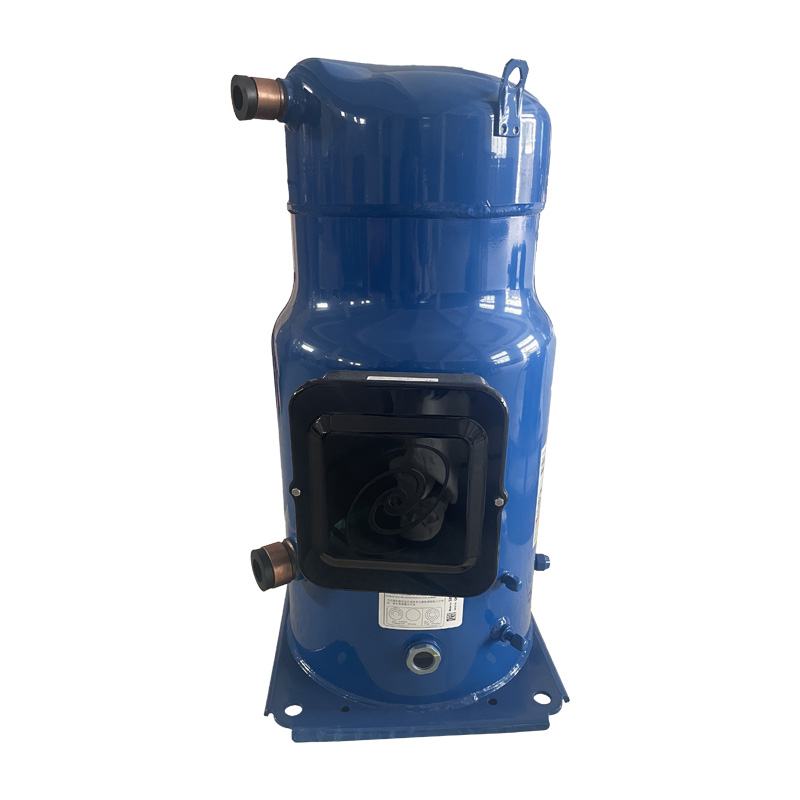
1. Danfoss Scroll compressors
Principle of operation:
Scroll disc design: At the heart of a scroll compressor are two scroll discs - one stationary, the other rotating around the first. The shape of these two discs allows them to gradually push the gas from the outer edge to the centre as they rotate, while gradually compressing the gas.
Continuous compression process: As the moving vortex discs rotate around the static vortex discs, the gas is continuously sucked in, enclosed in the chambers formed by the vortexes, and gradually moves towards the centre, where the gas decreases in volume and increases in pressure, and is finally discharged.
Features:
Energy efficient: Scroll compressors use advanced scroll technology to provide an excellent energy efficiency ratio (EER), significantly reducing energy consumption while ensuring high performance.
Low noise and vibration: Due to its unique scroll design, it generates low noise levels during operation, making it ideal for noise-sensitive application scenarios, such as residential areas or office environments.
High Reliability: Reduced number of moving parts reduces the risk of wear and tear and malfunctions, increasing the reliability and service life of the unit.
Environmentally friendly refrigerant compatibility: Supports the use of a wide range of environmentally friendly refrigerants such as R410A, R407C, R32, etc., which meets the requirements of current strict environmental regulations.
Application Scenarios:
Domestic air conditioning.
Commercial air conditioning.
Industrial refrigeration.
Heat pump system.
2. Danfoss Piston compressors
Principle of operation:
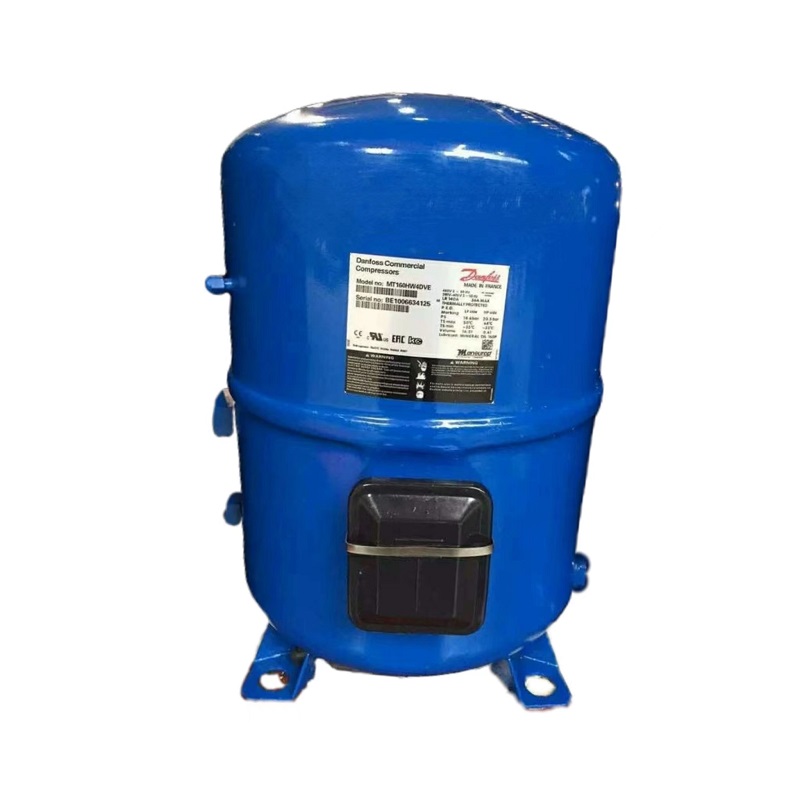
Reciprocating motion: A piston compressor compresses gas by means of the reciprocating motion of a piston in the cylinder. When the piston moves downwards, the gas enters the cylinder through the inlet valve; when the piston moves upwards, the gas is compressed and discharged through the exhaust valve.
Multi-stage compression: In order to achieve higher pressures, some piston compressors use multi-stage compression, where the gas is compressed in several stages to achieve the desired pressure level.
Features:
Wide operating range: Piston compressors are able to operate stably over a wide range of temperatures, maintaining good performance in both high and low temperature conditions.
High compression ratio: For applications requiring a high compression ratio, such as some special industrial refrigeration needs.
Cost-effective: For some applications with limited budgets, piston compressors may be a more cost-effective option.
Application Scenarios:
Commercial refrigeration.
Industrial refrigeration.
Special process cooling.
3. Danfoss Inverter Compressors
Principle of operation:
Inverter Drive: Inverter compressors use a frequency converter to control the speed of the motor, thereby dynamically adjusting the compressor's output to the actual load demand. This not only improves energy efficiency, but also provides more precise temperature control.
Intelligent Adjustment: Environmental conditions are monitored in real time by sensors and fed back to the control system, which adjusts the compressor's operating state accordingly to achieve energy efficiency and performance optimisation.
Features:
Variable Frequency Regulation: Match the actual demand of the system by adjusting the motor speed to achieve higher energy efficiency.
Precise control: Able to automatically adjust the output capacity according to the load changes, providing more accurate temperature control.
Reduced Starting Current Shock: Inverter start can effectively reduce the current shock during start-up and extend the life of the compressor.
Application Scenarios:
Precision air conditioning.
Data centre cooling.
High-end commercial building air-conditioning system.
4. Danfoss Maglev oil-free compressors
Principle of operation:
Magnetic Levitation Bearings: This type of compressor utilises magnetic levitation technology to keep the rotor suspended in the air, avoiding the friction losses and wear problems associated with traditional mechanical bearings. The lack of physical contact means that there are virtually no mechanical losses, which greatly improves the energy efficiency ratio.
Oil-free design: As no lubricating oil is required, maglev compressors avoid the problem of efficiency loss due to oil contamination, making them particularly suitable for applications with high cleanliness requirements.
Features:
Oil-free design: No lubricating oil is required for operation, avoiding the problem of reduced efficiency caused by oil contamination in traditional compressors.
Energy efficient: Maglev bearing technology reduces mechanical friction losses, further improving energy efficiency.
Low Maintenance Requirements: The absence of an oil circuit system means reduced maintenance effort and costs.
Application Scenarios:
High efficiency data centre cooling.
Medical facilities.
Laboratory environments.
5. Danfoss Screw Compressors
Principle of operation:
Screw Rotors: Screw compressors rely on a pair of intermeshing helical rotors to compress gas. As the rotors rotate, the gas is drawn in and gradually compressed between the rotors until it reaches a set pressure value and is discharged.
Capacity Adjustment: The effective volume of the compressor can be changed by slide valve adjustment to adapt to different load requirements, to achieve the function of continuously adjustable capacity.
Features:
High compression ratio: Suitable for applications requiring higher pressures.
Continuously adjustable capacity: The effective volume of the compressor can be changed by slide valve adjustment to adapt to different load requirements.
Strong durability: Robust structure, suitable for long time continuous operation.
Application Scenario:
Large industrial refrigeration.
Pharmaceutical industry.


